
Quick answer
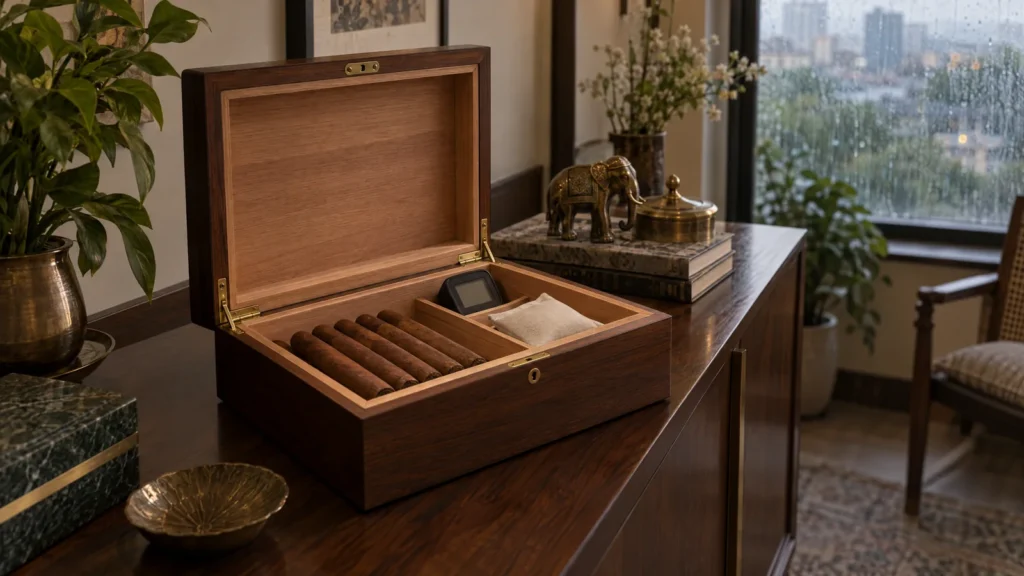
Keep cigars in a closed humidor or airtight box with a two-way 65% humidity pack, away from windows and outside walls, and check the hygrometer once a week. Aim for 65–70% inside the box, and keep the room as cool as you can.
In short
- Switch to a 65% two-way humidity pack before the rains, and never mix pack strengths in one box.
- Keep the box on an inside wall, off the floor, away from windows, the bathroom and the kitchen.
- Check the hygrometer and the cigars once a week, and again after a storm or a long power cut.
- If the reading stays above 70% for more than a few days, add a fresh 65% pack or move the box somewhere cooler and drier.
- Take out any cigar with mould or tiny pinholes straight away, and keep it away from the rest.
From June to September, the air across much of India stays damp for weeks at a time, so storing cigars in the monsoon needs a little care. Inside a closed humidor that is manageable. But a box left by a window, or a cabinet with the wrong pack, can drift high enough to tighten the draw, split wrappers and invite mould.
This guide is the season’s checklist: what to change before the rains arrive, where the box should live, the five-minute weekly check, what to do after a storm or a power cut, and how to tell mould from plume and spot tobacco beetles early. It is written for Indian homes, where the outside air can sit above 80% humidity for days while the temperature stays in the high twenties or thirties.
For the full picture of year-round storage, read How to store cigars in India.
Contents
Why the monsoon is hard on cigars
A cigar is dried, fermented leaf, and it never stops trading moisture with the air around it. In a dry room it gives moisture up; in damp air it takes moisture in. A good humidor slows that exchange down and holds the cigars near 65–70% relative humidity, which is where the wrapper stays supple, the filler burns evenly and the oils that carry flavour are kept in.
The monsoon pushes from the wet side. When the box creeps above about 72–75% and stays there, three things start to happen:
- The draw tightens. The filler leaves swell, so the cigar pulls hard and burns unevenly. You relight more often and the smoke tastes flat or bitter.
- Wrappers split. A swollen cigar that is then lit, or carried into an air-conditioned room, can crack along the wrapper.
- Mould gets a foothold. Warm, still, damp air is exactly what mould needs. It usually starts on the foot or under the band and spreads from cigar to cigar.
Heat adds a fourth risk. Tobacco beetle eggs are present in almost all tobacco, and they can hatch when the storage area stays above about 24°C for long periods. Many Indian homes are warmer than that through the monsoon, which is why a cool room matters as much as the right humidity pack.
When the rains reach your city
India has no single monsoon. The south-west monsoon usually reaches Kerala in early June and spreads north over the following weeks, while Chennai and the Tamil Nadu coast get most of their rain later, from the north-east monsoon. Use this as a rough guide to when your storage needs to be ready:
| Where you are | Typical wet season | What to watch |
|---|---|---|
| Kerala and coastal Karnataka | June to September | Very heavy, long rain; keep the box on an inside wall and check weekly from day one |
| Mumbai, Konkan and Goa | June to September | Sea air and heavy rain together; humidity stays high even between showers |
| Kolkata and the east | June to September | Hot and damp together; watch temperature as closely as humidity |
| Guwahati and the North-East | Late spring into October | One of the longest wet seasons in India; plan for months, not weeks |
| Delhi and the north-west | July to September | Shorter, but hot and sticky between showers; power cuts are the bigger risk |
| Bengaluru, Pune and Hyderabad | June to September | Milder temperatures help; humidity still rises inside cupboards |
| Chennai and the Tamil Nadu coast | October to December | Your main rains come later; keep monsoon settings into winter |
The dates move from year to year. The useful habit is simple: switch your setup when the first proper rains arrive where you live, not when the calendar says June.
Before the rains: set up in June
- Use a 65% pack. A two-way humidity pack absorbs moisture when the air in the box is damp and releases it when the air is dry. We suggest 65% for Cuban cigars and for the monsoon months; 69% suits a mixed collection for the rest of the year. You can buy Boveda 65% Size 60 from our Boveda store.
- Never mix strengths. Take the old packs out before you add new ones, so a 65% and a 69% pack don’t work against each other in the same box. Don’t run Boveda alongside beads, sponges or any other humidifier either.
- Check how many packs you need. Go by the humidor’s capacity, not by how many cigars are in it today: one Size 60 pack for up to 25 cigars, two for up to 50, and four Size 60 packs or one Size 320 pack for up to 100.
- Replace tired packs. Boveda says to replace its cigar packs every three months. A pack that has turned hard all the way through has already run out.
- Test the hygrometer. Check its accuracy the way its maker recommends, so you can trust the weekly reading. A hygrometer that reads 5% low will have you adding moisture to a box that is already too wet.
- Season a new humidor first. If you bought a wooden humidor this year, season the cedar before the cigars go in: Boveda 84% packs in the empty, closed box for fourteen days, then take them out and switch to your storage packs.
- Check the lid. Close the lid on a strip of paper. If it slides out with no resistance, the seal is loose and damp air will get in. Store the box somewhere drier, or move the cigars into an airtight container for the season.
| Humidor capacity | Size 60 packs | Or |
|---|---|---|
| Up to 25 cigars | 1 | |
| Up to 50 cigars | 2 | |
| Up to 75 cigars | 3 | |
| Up to 100 cigars | 4 | 1 × Size 320 |
Choosing a container for the rains
Any container that closes well can get your cigars through the monsoon, as long as it holds the right pack. Each type behaves a little differently in damp weather:
- Wooden humidor. Spanish cedar soaks up and releases moisture, which buffers small swings. It needs seasoning, and a loose lid lets damp air in. Browse our humidors.
- Acrylic humidor. Needs no seasoning and seals tightly, so the pack does all the work and the reading moves less with the weather. Our acrylic humidor comes with a digital hygrometer.
- Airtight plastic or glass box. The cheapest option and one of the most stable in the monsoon, because outside air barely gets in. Add a hygrometer and the right number of packs for its size.
- Humidor bag. A resealable bag with a humidity pack sealed inside: nothing to season and nothing to set up. Refill Boveda humidor bags with 69% packs only; higher levels can lead to mould in a bag.
- Wine cooler or cooled cabinet. The only home option that also controls temperature. Useful in hot, humid cities, but it needs its own humidity packs and a hygrometer inside.
Where to keep the box
- On an inside wall. Outside walls and window sills turn damp in the rains.
- Off the floor, and away from the bathroom, the kitchen and anywhere clothes are dried, where steam and damp build up.
- Out of direct sun, and not in the direct blast of an air conditioner.
- In the coolest room you have. Ideally the room stays between 19°C and 23°C. Our shop storage cabinets run at 18–21°C, and cigars held in The Slow Draw Vault are kept cooler still, at 17°C.
- With the lid closed. Leaving it open “to let the cigars breathe” lets the room’s damp air straight in.
Wardrobes and cupboards are tempting because they are dark, but in the monsoon they often hold the dampest air in the house. If you use one, keep the door closed, keep the box raised off the cupboard floor, and check it as often as you would a box on a shelf.
Air conditioning, dehumidifiers and power cuts
An air-conditioned room is usually the best place for a humidor in the monsoon. The AC cools the air and pulls moisture out of it, so the room sits closer to the conditions cigars like. Keep the box out of the airflow itself, though: a cold, dry draught across one side of a wooden humidor can dry and warp the lid while the rest of the box stays damp.
If the AC runs only at night, expect the reading to move a little between day and night. That is normal. What matters is the trend over a week, not a single reading taken at the warmest part of the afternoon.
A room dehumidifier helps in very damp flats, but don’t put the humidor right next to it, and never use one inside a humidor. Two-way packs work best when the air around the box is steady.
Power cuts are the real hazard. When the AC stops, the room warms up quickly and the humidity in it rises. A humidor that has been sitting at 66% can drift several points higher over a long outage, and the temperature can climb into the range where beetles become active. Keep the lid closed, don’t open the box to “check” during the cut, and look at it properly the next day.
The weekly check: five minutes
Once a week from June to September, open the box once and go through this list.
- Read the hygrometer. You want 65–70% inside the box. A high reading just after you have opened the lid is normal; a reading that stays above 70% for several days is not.
- Note the temperature too. If the box is regularly above 24°C, look for a cooler spot.
- Do the pinch test. Roll a cigar gently near the foot. It should give slightly and spring back, like a ripe plum. A soft, spongy feel means it is holding too much moisture.
- Look at the packs. Soft packs are working. Hard ones need replacing.
- Look at the cigars. Fuzzy or coloured spots that sit on the wrapper are mould. Tiny round pinholes, or fine tobacco dust in the bottom of the box, point to tobacco beetles. Either way, take the affected cigars out at once.
- Close the lid and leave it. Opening and adjusting the box again and again does more harm than a small swing in the reading.
Write the reading and the date down. A simple note on your phone or in The Companion, our free tasting journal, turns four weekly readings into a pattern you can act on.
Mould, plume and tobacco beetles
Mould or plume?
Plume, sometimes called bloom, is a fine, even, powdery dusting on the wrapper. It brushes off easily with a soft brush and leaves no stain behind. Many smokers regard it as harmless, but it can look worrying the first time you see it.
Mould is different. It is fuzzy or cobweb-like, often bluish-green, white or grey, and it tends to appear in patches, on the foot, under the band or where two cigars touch. It can leave a stain on the wrapper and often smells musty. If you are not sure which you are looking at, treat it as mould until you have asked.
If you find mould
- Take the affected cigars out straight away and keep them in a separate bag, away from the rest.
- Check every cigar that was touching them, and look at the cedar inside the box.
- Bring the humidity down: fresh 65% packs, a cooler room, and no extra humidifiers.
- Watch the rest of the collection closely for the next two weeks.
- If mould is growing on the wood of the humidor itself, or you bought the cigars from us recently, send us a clear photo before you do anything else.
Tobacco beetles
Beetles show themselves through tiny round holes in the wrapper, tunnels through the cigar, and fine tobacco dust gathering in the bottom of the box. They are a heat problem more than a damp problem: keeping the storage area below about 24°C is the best prevention.
If you find beetle damage, remove the affected cigars at once. Many collectors then freeze the remaining cigars to kill any eggs: sealed in a zip-lock bag (or two), a day in the fridge, around three days in the freezer, then a day back in the fridge before they return to room temperature, unopened, so moisture doesn’t condense on the wrappers. Freezing is a one-off rescue step, never a way to store cigars.
Signs your cigars are too wet, and how to bring them back
Over-humidified cigars rarely look wrong at first. The clues are in how they feel and smoke: a spongy give along the whole length, a cold draw that feels like sucking through a wet straw, a burn that keeps tunnelling or going out, and a sour or bitter edge to the smoke that wasn’t there before. Wrappers can also look darker and slightly swollen around the band.
The fix is patience, not heat. Never dry cigars in the sun, on top of the AC unit or with a hair dryer; fast drying cracks wrappers and drives off the oils you are trying to keep. Instead:
- Take out any extra humidifiers, and leave only fresh 65% packs in the box.
- Move the box to the coolest, driest room you have, and keep the lid closed.
- Give it time. Cigars lose moisture slowly, so expect a week or more before they feel right again.
- Before smoking a cigar that has been in a damp box, some smokers “dry box” it: an hour or two out of the humidor, or a day in a closed container with no humidity pack, so the wrapper and the first third burn more evenly.
If cigars have been very wet for a long time, check them closely for mould before you smoke them, and let them settle in a steady box for a few weeks.
After heavy rain or a long power cut
Storms and power cuts are when boxes go wrong: the room warms up and damp air gets in.
- Check the box the next day, even if it isn’t your usual check day. Read the hygrometer and feel a cigar.
- If the reading stays high, add one fresh 65% pack to soak up the extra moisture, or move the box to a cooler, drier room. Don’t leave the lid open to dry it out; the room is usually wetter than the box.
- If a cigar feels spongy, let it rest in the box for a few days before you smoke it. A swollen cigar draws tight and can crack when lit.
- If water got into the box, take the cigars out. A cigar that has been soaked rarely recovers, so set aside any that got wet and keep an eye on the rest.
- If you find mould or pinholes, remove those cigars, keep them away from the rest of your collection, and check the cigars that were touching them.
Travelling with cigars in the rains
For a weekend away, a sealed zip-lock bag or a small travel humidor with a Size 8 Boveda pack is enough. Keep it in your bag rather than the car boot, away from the hotel room’s AC vent, and out of the sun on a balcony. When you get home, put the cigars back into the humidor rather than leaving them in the travel bag for weeks.
Buying cigars in the rains
Every order from The Slow Draw ships in a sealed pouch with a Boveda 69% humidity pack already inside, so the cigars travel at a steady humidity even in monsoon weather. We open and check each box for humidity, cracked wrappers and construction before it ships, send you a packing video of your order, and ship by express courier once the order is confirmed and your age is verified.
Keep the pouch sealed until the cigars go into your humidor; if you plan to smoke them within a few days, they can stay in it. Many smokers let new cigars rest for a week or two after a journey before lighting them. If a cigar arrives with mould, contact us within 48 hours of delivery.
You can buy humidity packs from our Boveda store, and humidors and airtight boxes from our humidor collection.
After the monsoon
When the rains end, the air dries out quickly in most of India. Many collections go back to 69% once the season is over. In a dry North Indian winter, a box with a loose lid may need 72% to stay in range. In Chennai and along the Tamil Nadu coast, keep your monsoon settings until the north-east monsoon has passed, usually by the end of December.
Change one thing at a time: swap the packs, then watch the hygrometer for a week before you change anything else.
Month-by-month checklist
| When | What to do |
|---|---|
| Late May or first rains | Test the hygrometer, replace old packs with 65%, check the lid seal, find the coolest inside wall |
| June | Weekly check begins; season any new wooden humidor before cigars go in |
| July | Peak rain in most cities; check again after every storm or long power cut |
| August | Replace packs that are three months old or have turned hard; inspect for mould and beetles |
| September | Keep checking weekly; the end of the rains is often the warmest, stickiest stretch |
| October onwards | Switch back to 69% (or 72% in a dry northern winter); Chennai keeps monsoon settings to December |
When home storage isn’t enough
Some homes simply can’t hold steady conditions through an Indian monsoon and summer, especially without reliable power or a cool room. If that is you, The Slow Draw Vault keeps boxes bought from us in a compressor-cooled cabinet at 17°C and 65–68% humidity, on backup power, with alarms and a quarterly check of every box. You can collect or courier them whenever you like.
Explore next
How to store cigars in India, our Boveda store and our full cigar range.
Frequently asked questions
What humidity should cigars be kept at during the monsoon?
65–70% inside the box. A two-way 65% pack holds the lower end of that range and gives you a buffer when the air outside is damp.
Should I leave the humidor open to let the cigars breathe?
No. In the monsoon the room is usually wetter than the box. Keep the lid closed and let the pack do the work.
Can I keep cigars in the fridge?
No. A fridge is too cold and dries the air, and cigars pick up food smells. The fridge and freezer are only used briefly to rescue cigars from tobacco beetles.
How often should I check my humidor in the rains?
Once a week, and again after a storm or a long power cut.
How do I tell mould from plume?
Plume is a fine, even powder that brushes off without a mark. Mould is fuzzy, patchy, often bluish-green or white, and can stain the wrapper. If in doubt, treat it as mould and remove the cigar.
Is an airtight box better than a wooden humidor in the monsoon?
Often, yes. An airtight box lets very little damp air in, so a 65% pack can hold it steady with less effort. A wooden humidor works well too if the lid seals properly.
Should I change the pack again after the monsoon?
Many collections go back to 69% once the rains end, and a box with a loose lid may need 72% in a dry North Indian winter. In Chennai, keep monsoon settings until the north-east monsoon ends.
For adult readers. Tobacco use is harmful to health; this guide is about storage, not safety of use.


0 Comments
No comments yet. Start the conversation.
Please log in to join the discussion.